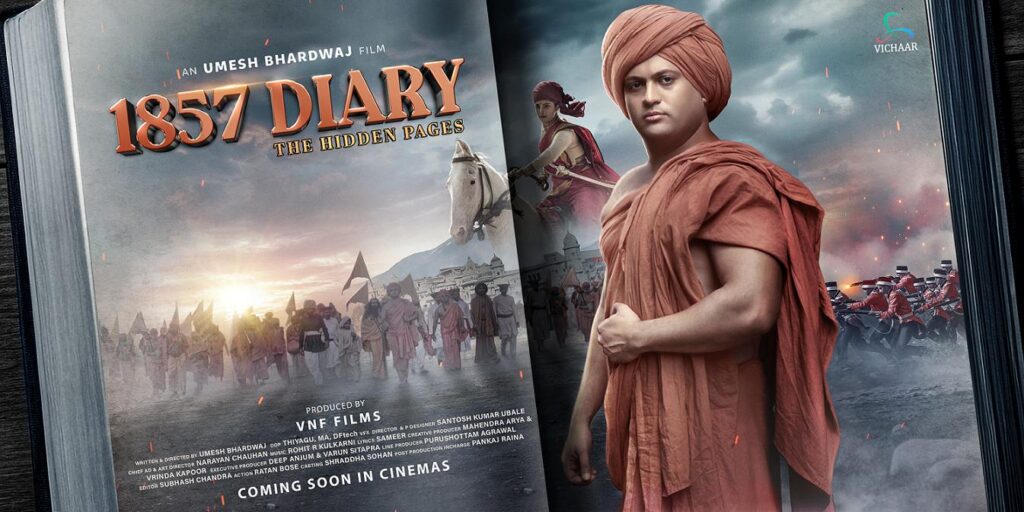
Step into Mahendra Arya’s cinematic journey, where he brings stories to life as a creative producer, lyricist, writer and singer. In the historical film 1857 Diary: The Hidden Pages, his powerful songs “Tu Kahe Ka Malik Hai” and “Chalo Kumbh Ki Ore” blend emotion, history and devotion on screen.
1857 Diary- The Hidden Pages : A Riveting Tale of India’s Revolutionary History
1857 Diary- The Hidden Pages, a gripping historical drama that brings to life the untold stories of India’s first war of independence. Directed and written by Umesh Bhardwaj, this cinematic masterpiece delves deep into the forgotten pages of history, shedding light on the pivotal role played by spiritual leaders and revolutionaries in shaping India’s struggle for freedom.
A Powerful Narrative of Patriotism and Resistance
Since ancient times, India has been a land of great sages, warriors, and revolutionaries who have stood up against oppression. The film highlights how religious and spiritual leaders have played a crucial role in guiding India’s fight against foreign invaders, from the Mongols and Mughals to the British. 1857 – The Hidden Pages explores the clandestine efforts of Swami Omanand and Swami Purnanand, who, during the 1855 Haridwar Kumbh, entrusted the mission of national awakening to Swami Dayanand Saraswati. His call for Swadharm and Swaraj inspired generations of freedom fighters, including Sardar Bhagat Singh, Lala Lajpat Rai, Ramprasad Bismil, and Shyamji Krishna Varma.
Chalo Kumbh Ki Ore: A Beautiful Song That Captures the Spirit
Adding to the film’s emotional depth is the song Chalo Kumbh Ki Ore from 1857 Diary- The Hidden Pages. This soulful track, beautifully penned and expressed by Mahendra Arya, perfectly encapsulates the essence of devotion and patriotism. Chalo Kumbh Ki Ore – A Song that Awakens the Cultural Soul of India
Chalo Kumbh Ki Ore, is a moving tribute to the spiritual grandeur of the Prayagraj Maha Kumbh and the depth of India’s cultural heritage. The sacred grandeur of the Prayagraj Maha Kumbh, a timeless emblem of India’s spiritual and cultural pride, is captivating the entire world. Immortal singer Udit Narayan brings this creation to life with his golden voice, while lyricist Mahendra Arya captures the divinity of the Kumbh, the penance of saints, and the grandeur of Sanatan culture in evocative words. Composer Rohit Kulkarni enriches the composition with a blend of spirituality and patriotic fervour. The historical setting of the song takes us back to the Haridwar Maha Kumbh of 1855 – the moment when a grand assembly of saints lit the first spark of resistance against the British Empire, laying the foundation for the 1857 revolution. Directed and written by Umesh Bhardwaj and produced under the banner of VNF Films, the film unveils the hidden and forgotten chapters of India’s freedom struggle.
Chalo Kumbh Ki Ore stands as a symbol of India’s cultural heritage, social unity, and national pride.
Revolutionary Song – Tu Kahe Ka Malik Hai
This song revives the indomitable roar of India’s First War of Independence in 1857 – the call that shook the very foundations of colonial rule. It echoes the immortal voice that- “Awakened a nation, shook the empire, and lit the eternal flame of Swadharma and Swarajya in the hearts of Indians.”
Essence of the Song: More than just music, this song is a historical invocation – a reminder that when India stands united against oppression, the strength of courage and sacrifice is born. It rekindles the memory of martyrs and reignites the flame of patriotism within every Indian.
Musical Excellence: Penned by lyricist Mahendra Arya, the song has been soulfully rendered by Sandeep Banerjee, Krishna Beura, and Mahendra Arya himself. The musical brilliance of Dhvanit Joshi has given this composition an unforgettable depth, making it an experience that touches the soul.